.png)
.png)
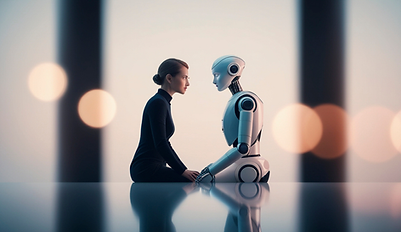
Humans vis à vis Artificial Intelligence
The Chinese View
9 Sept 2026

China's top court has firmly reinforced the "human-inventor rule." China's National Intellectual Property Administration (CNIPA) and its Patent Examination Guidelines explicitly state that only a natural person can be legally recognised as an inventor, excluding Artificial Intelligence systems from holding that title.[1]
The DABUS Test Case:
This rule was recently tested through Stephen Thaler’s famous "DABUS" patent application (which has been testing AI inventorship laws globally). CNIPA formally rejected Thaler's application because he listed the DABUS AI as the inventor. They upheld this rejection during re-examination, and Thaler's legal challenge against this decision is currently pending before the Beijing Intellectual Property Court.
The Legal Horizon:
While the baseline rule is now clear (the named inventor must be human), the article notes that the legal battleground will now shift to the "human-contribution standard." Future litigation in China will likely focus on how much human input or oversight is required to claim a patent when an AI system did the heavy lifting to generate the invention.
This is highly relevant to the AI patent trends we were talking about! While the UK is making it easier to patent AI software itself (like the Emotional Perception case), China is firmly drawing the line on who (or what) gets the legal credit for inventing it.
The DABUS Strategy
Stephen Thaler’s DABUS (Device for the Autonomous Bootstrapping of Unified Sentience) wasn’t just an AI; it was a deliberate legal provocation. Thaler created inventions using DABUS (like a food container and a flashing beacon) and intentionally listed the AI as the sole inventor on patent applications worldwide.
His goal was to force global patent offices to answer a simple question: Can a machine be an inventor?
The US, UK, and EU: All firmly said no. The UK Supreme Court shut Thaler down in late 2023, stating an inventor must be a "natural person."[2]
China’s Stance: As the article notes, China is aligning with this global heavyweight consensus. The CNIPA is strictly enforcing its rule that the paperwork must list a human name.
The Real Fight: The "Human-Contribution Standard"
The most important part of the IP fray headline is the second half: the scope of human contribution is likely to be tested.
Now that courts have definitively said "an AI cannot be the inventor," companies are simply putting human names on the applications for AI-generated inventions. But this opens a legal minefield for future litigation. If a competitor wants to invalidate your patent, they will attack the "human contribution" by asking:
Did a human truly invent this? If a human just typed a prompt into a generative AI (e.g., "design a more aerodynamic turbine blade"), did they conceive the invention, or did the AI?
The "Recognition" Argument: If the AI generates 10,000 chemical compounds and a human scientist identifies the one that cures a disease, does the act of recognising the solution count as invention?
Way forward for the IP Industry
This creates a fascinating narrative for the IP sector, where shifting from theoretical debates about sentient machines to highly technical legal battles over R&D workflows, prompt engineering, and the definition of human ingenuity.
It’s exactly the kind of high-stakes, disruptive topic that dominates panel discussions at major conferences and serves as anchor content for publications focusing on IP tech and innovation services. Law firms and tech companies need clarity on how to structure their R&D departments so courts don't dismiss their AI-assisted patents.

Feature written by Kushraj Singh, Senior Legal Correspondent, The Global IP Magazine.
Email Kushraj: newsdesk@northonsprmarketing.com
Sources: [1] Chatterton, E. & Hurcombe, L. (February 26, 2025). China Releases Guidelines for AI-Related Patent Applications. DLA Piper. https://www.dlapiper.com/en-am/insights/publications/2025/02/china-releases-guidelines-for-ai-related-invention-patent-applications [2] Blackford, L., Turner, S. & Barton, B. (December 27, 2023). UK Supreme Court confirms inventor must be a real person, providing critical guidance on AI-generated inventions. DLA Piper. https://www.dlapiper.com/en-eu/insights/publications/2023/12/uk-supreme-court-confirms-inventor-must-be-a-real-person




Submit Intellectual Property
News & Legal Updates
The Global IP Magazine welcomes submissions of verified intellectual property law news for publication within our website Press Room. This includes court decisions, regulatory changes, policy updates, legislative reforms, and major international IP developments that impact the global IP landscape.
If you have a significant IP case outcome, legal update, government notice, or regulatory development to share, you may submit it below for editorial consideration.